MoreExam
1. Question Content...
EXPLANATION
Answer: X - EXPLANATION Content.
Question1: Your finance team wants to view the billing report for your projects. You want to make sure that the finance team does not get additional permissions to the project. What should you do?
Question2: You have designed a solution on Google Cloud Platform (GCP) that uses multiple GCP products. Your company has asked you to estimate the costs of the solution. You need to provide estimates for the monthly total cost. What should you do?
Question3: You need to create a copy of a custom Compute Engine virtual machine (VM) to facilitate an expected increase in application traffic due to a business acquisition. What should you do?
Question4: You have a large 5-TB AVRO file stored in a Cloud Storage bucket. Your analysts are proficient only in SQL and need access to the data stored in this file. You want to find a cost-effective way to complete their request as soon as possible. What should you do?
Question5: You are running a data warehouse on BigQuery. A partner company is offering a recommendation engine based on the data in your data warehouse. The partner company is also running their application on Google Cloud. They manage the resources in their own project, but they need access to the BigQuery dataset in your project. You want to provide the partner company with access to the dataset What should you do?
Question6: You host a static website on Cloud Storage. Recently, you began to include links to PDF files on this site. Currently, when users click on the links to these PDF files, their browsers prompt them to save the file onto their local system. Instead, you want the clicked PDF files to be displayed within the browser window directly, without prompting the user to save the file locally. What should you do?
Question7: You need to configure optimal data storage for files stored in Cloud Storage for minimal cost. The files are used in a mission-critical analytics pipeline that is used continually. The users are in Boston, MA (United States). What should you do?
Question8: You need to verify that a Google Cloud Platform service account was created at a particular time. What should you do?
Question9: Your company uses Cloud Storage to store application backup files for disaster recovery purposes. You want to follow Google's recommended practices. Which storage option should you use?
Question10: You want to select and configure a cost-effective solution for relational data on Google Cloud Platform. You are working with a small set of operational data in one geographic location. You need to support point-in-time recovery. What should you do?
Question11: Your company publishes large files on an Apache web server that runs on a Compute Engine instance. The Apache web server is not the only application running in the project. You want to receive an email when the egress network costs for the server exceed 100 dollars for the current month as measured by Google Cloud Platform (GCP). What should you do?
Question12: Every employee of your company has a Google account. Your operational team needs to manage a large number of instances on Compute Engine. Each member of this team needs only administrative access to the servers. Your security team wants to ensure that the deployment of credentials is operationally efficient and must be able to determine who accessed a given instance. What should you do?
Question13: You are using Container Registry to centrally store your company's container images in a separate project. In another project, you want to create a Google Kubernetes Engine (GKE) cluster. You want to ensure that Kubernetes can download images from Container Registry. What should you do?
Question14: You are hosting an application from Compute Engine virtual machines (VMs) in us-central1- a. You want to adjust your design to support the failure of a single Compute Engine zone, eliminate downtime, and minimize cost. What should you do?
Question15: Your organization has a dedicated person who creates and manages all service accounts for Google Cloud projects. You need to assign this person the minimum role for projects. What should you do?
Question16: You need to produce a list of the enabled Google Cloud Platform APIs for a GCP project using the gcloud command line in the Cloud Shell. The project name is my-project. What should you do?
Question17: You have successfully created a development environment in a project for an application. This application uses Compute Engine and Cloud SQL. Now, you need to create a production environment for this application.The security team has forbidden the existence of network routes between these 2 environments, and asks you to follow Google-recommended practices. What should you do?
Question18: Your company set up a complex organizational structure on Google Could Platform. The structure includes hundreds of folders and projects. Only a few team members should be able to view the hierarchical structure. You need to assign minimum permissions to these team members and you want to follow Google-recommended practices. What should you do?
Question19: Your VMs are running in a subnet that has a subnet mask of 255.255.255.240. The current subnet has no more free IP addresses and you require an additional 10 IP addresses for new VMs. The existing and new VMs should all be able to reach each other without additional routes. What should you do?
Question20: You have a developer laptop with the Cloud SDK installed on Ubuntu. The Cloud SDK was installed from the Google Cloud Ubuntu package repository. You want to test your application locally on your laptop with Cloud Datastore. What should you do?
Question21: You need to create an autoscaling managed instance group for an HTTPS web application. You want to make sure that unhealthy VMs are recreated. What should you do?
Question22: You have a project for your App Engine application that serves a development environment. The required testing has succeeded and you want to create a new project to serve as your production environment. What should you do?
Question23: &. You are working for a hospital that stores Its medical images in an on-premises data room. The hospital wants to use Cloud Storage for archival storage of these images. The hospital wants an automated process to upload any new medical images to Cloud Storage. You need to design and implement a solution. What should you do?
Question24: Your company's infrastructure is on-premises, but all machines are running at maximum capacity. You want to burst to Google Cloud. The workloads on Google Cloud must be able to directly communicate to the workloads on-premises using a private IP range. What should you do?
Question25: You have a virtual machine that is currently configured with 2 vCPUs and 4 GB of memory. It is running out of memory. You want to upgrade the virtual machine to have 8 GB of memory. What should you do?
Question26: For analysis purposes, you need to send all the logs from all of your Compute Engine instances to a BigQuery dataset called platform-logs. You have already installed the Stackdriver Logging agent on all the instances. You want to minimize cost. What should you do?
Question27: You have an application on a general-purpose Compute Engine instance that is experiencing excessive disk read throttling on its Zonal SSD Persistent Disk. The application primarily reads large files from disk. The disk size is currently 350 GB. You want to provide the maximum amount of throughput while minimizing costs. What should you do?
Question28: You received a JSON file that contained a private key of a Service Account in order to get access to several resources in a Google Cloud project. You downloaded and installed the Cloud SDK and want to use this private key for authentication and authorization when performing gcloud commands. What should you do?
Question29: You want to add a new auditor to a Google Cloud Platform project. The auditor should be allowed to read, but not modify, all project items.How should you configure the auditor's permissions?
Question30: You have an application that uses Cloud Spanner as a backend database. The application has a very predictable traffic pattern. You want to automatically scale up or down the number of Spanner nodes depending on traffic. What should you do?
Question31: 2. Your auditor wants to view your organization's use of data in Google Cloud. The auditor is most interested in auditing who accessed data in Cloud Storage buckets. You need to help the auditor access the data they need. What should you do?
Question32: You have 32 GB of data in a single file that you need to upload to a Nearline Storage bucket. The WAN connection you are using is rated at 1 Gbps, and you are the only one on the connection. You want to use as much of the rated 1 Gbps as possible to transfer the file rapidly. How should you upload the file?
Question33: You need to deploy an application, which is packaged in a container image, in a new project. The application exposes an HTTP endpoint and receives very few requests per day. You want to minimize costs. What should you do?
Question34: An application generates daily reports in a Compute Engine virtual machine (VM). The VM is in the project corp-iot-insights. Your team operates only in the project corp-aggregate-reports and needs a copy of the daily exports in the bucket corp-aggregate-reports-storage. You want to configure access so that the daily reports from the VM are available in the bucket corp-aggregate-reports-storage and use as few steps as possible while following Google-recommended practices. What should you do?
Question35: You want to run a single caching HTTP reverse proxy on GCP for a latency-sensitive website. This specific reverse proxy consumes almost no CPU. You want to have a 30-GB in-memory cache, and need an additional 2 GB of memory for the rest of the processes. You want to minimize cost. How should you run this reverse proxy?
Question36: You are building a pipeline to process time-series data. Which Google Cloud Platform services should you put in boxes 1,2,3, and 4?
Question37: You manage three Google Cloud projects with the Cloud Monitoring API enabled. You want to follow Google-recommended practices to visualize CPU and network metrics for all three projects together. What should you do?
Question38: You have created a code snippet that should be triggered whenever a new file is uploaded to a Cloud Storage bucket. You want to deploy this code snippet. What should you do?
Question39: You need to enable traffic between multiple groups of Compute Engine instances that are currently running two different GCP projects. Each group of Compute Engine instances is running in its own VPC. What should you do?
Question40: You are using multiple configurations for gcloud. You want to review the configured Kubernetes Engine cluster of an inactive configuration using the fewest possible steps. What should you do?
Question41: You want to send and consume Cloud Pub/Sub messages from your App Engine application. The Cloud Pub/Sub API is currently disabled. You will use a service account to authenticate your application to the API. You want to make sure your application can use Cloud Pub/Sub. What should you do?
Question42: You are assigned to maintain a Google Kubernetes Engine (GKE) cluster named dev that was deployed on Google Cloud. You want to manage the GKE configuration using the command line interface (CLI). You have just downloaded and installed the Cloud SDK. You want to ensure that future CLI commands by default address this specific cluster. What should you do?
Question43: You are managing a Data Warehouse on BigQuery. An external auditor will review your company's processes, and multiple external consultants will need view access to the data. You need to provide them with view access while following Google-recommended practices. What should you do?
Question44: You need to create a Compute Engine instance in a new project that doesn't exist yet. What should you do?
Question45: You have created an application that is packaged into a Docker image. You want to deploy the Docker image as a workload on Google Kubernetes Engine. What should you do?
Question46: You need to manage a Cloud Spanner Instance for best query performance. Your instance in production runs in a single Google Cloud region. You need to improve performance in the shortest amount of time. You want to follow Google best practices for service configuration. What should you do?
Question47: You create a Deployment with 2 replicas in a Google Kubernetes Engine cluster that has a single preemptible node pool. After a few minutes, you use kubectl to examine the status of your Pod and observe that one of them is still in Pending status:What is the most likely cause?
Question48: You need to create a new billing account and then link it with an existing Google Cloud Platform project. What should you do?
Question49: A team of data scientists infrequently needs to use a Google Kubernetes Engine (GKE) cluster that you manage. They require GPUs for some long-running, non-restartable jobs. You want to minimize cost. What should you do?
Question50: You need to immediately change the storage class of an existing Google Cloud bucket. You need to reduce service cost for infrequently accessed files stored in that bucket and for all files that will be added to that bucket in the future. What should you do?
Question51: Your company implemented BigQuery as an enterprise data warehouse. Users from multiple business units run queries on this data warehouse. However, you notice that query costs for BigQuery are very high, and you need to control costs. Which two methods should you use? (Choose two.)
Question52: You are creating a Google Kubernetes Engine (GKE) cluster with a cluster autoscaler feature enabled. You need to make sure that each node of the cluster will run a monitoring pod that sends container metrics to a third-party monitoring solution. What should you do?
Question53: You are configuring service accounts for an application that spans multiple projects. Virtual machines (VMs) running in the web-applications project need access to BigQuery datasets in crm-databases-proj. You want to follow Google-recommended practices to give access to the service account in the web-applications project. What should you do?
Question54: You are migrating a production-critical on-premises application that requires 96 vCPUs to perform its task. You want to make sure the application runs in a similar environment on GCP. What should you do?
Question55: Your company runs one batch process in an on-premises server that takes around 30 hours to complete. The task runs monthly, can be performed offline, and must be restarted if interrupted. You want to migrate this workload to the cloud while minimizing cost. What should you do?
Question56: Your projects incurred more costs than you expected last month. Your research reveals that a development GKE container emitted a huge number of logs, which resulted in higher costs. You want to disable the logs quickly using the minimum number of steps. What should you do?
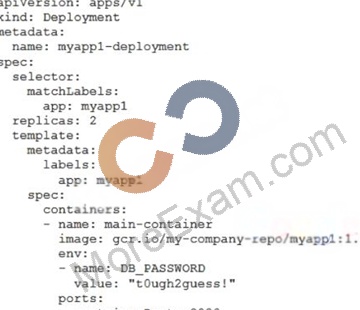
Question57: You've deployed a microservice called myapp1 to a Google Kubernetes Engine cluster using the YAML file specified below:You need to refactor this configuration so that the database password is not stored in plain text. You want to follow Google-recommended practices. What should you do?
Question58: A colleague handed over a Google Cloud Platform project for you to maintain. As part of a security checkup, you want to review who has been granted the Project Owner role. What should you do?
Question59: Your management has asked an external auditor to review all the resources in a specific project. The security team has enabled the Organization Policy called Domain Restricted Sharing on the organization node by specifying only your Cloud Identity domain. You want the auditor to only be able to view, but not modify, the resources in that project. What should you do?
Question60: 30. You are running multiple microservices in a Kubernetes Engine cluster. One microservice is rendering images. The microservice responsible for the image rendering requires a large amount of CPU time compared to the memory it requires. The other microservices are workloads that are optimized for n1-standard machine types. You need to optimize your cluster so that all workloads are using resources as efficiently as possible. What should you do?
Question61: You need to host an application on a Compute Engine instance in a project shared with other teams. You want to prevent the other teams from accidentally causing downtime on that application. Which feature should you use?
Question62: You are building an application that processes data files uploaded from thousands of suppliers. Your primary goals for the application are data security and the expiration of aged data. You need to design the application to:* Restrict access so that suppliers can access only their own data.* Give suppliers write access to data only for 30 minutes.* Delete data that is over 45 days old.You have a very short development cycle, and you need to make sure that the application requires minimal maintenance. Which two strategies should you use? (Choose two.)
Question63: You have a development project with appropriate IAM roles defined. You are creating a production project and want to have the same IAM roles on the new project, using the fewest possible steps. What should you do?
Question64: Your organization uses Active Directory (AD) to manage user identities. Each user uses this identity for federated access to various on-premises systems. Your security team has adopted a policy that requires users to log into Google Cloud with their AD identity instead of their own login. You want to follow the Google-recommended practices to implement this policy. What should you do?
Question65: You need to add a group of new users to Cloud Identity. Some of the users already have existing Google accounts. You want to follow one of Google's recommended practices and avoid conflicting accounts. What should you do?
Question66: You are using Google Kubernetes Engine with autoscaling enabled to host a new application. You want to expose this new application to the public, using HTTPS on a public IP address. What should you do?
Question67: You built an application on your development laptop that uses Google Cloud services. Your application uses Application Default Credentials for authentication and works fine on your development laptop. You want to migrate this application to a Compute Engine virtual machine (VM) and set up authentication using Google- recommended practices and minimal changes. What should you do?
Question68: You have an application running in Google Kubernetes Engine (GKE) with cluster autoscaling enabled. The application exposes a TCP endpoint. There are several replicas of this application. You have a Compute Engine instance in the same region, but in another Virtual Private Cloud (VPC), called gce-network, that has no overlapping IP ranges with the first VPC. This instance needs to connect to the application on GKE. You want to minimize effort. What should you do?
Question69: You are storing sensitive information in a Cloud Storage bucket. For legal reasons, you need to be able to record all requests that read any of the stored data. You want to make sure you comply with these requirements. What should you do?
Question70: Your company has workloads running on Compute Engine and on-premises. The Google Cloud Virtual Private Cloud (VPC) is connected to your WAN over a Virtual Private Network (VPN). You need to deploy a new Compute Engine instance and ensure that no public Internet traffic can be routed to it. What should you do?
Question71: You are building an application that stores relational data from users. Users across the globe will use this application. Your CTO is concerned about the scaling requirements because the size of the user base is unknown. You need to implement a database solution that can scale with your user growth with minimum configuration changes. Which storage solution should you use?
Question72: You built an application on Google Cloud Platform that uses Cloud Spanner. Your support team needs to monitor the environment but should not have access to table data. You need a streamlined solution to grant the correct permissions to your support team, and you want to follow Google-recommended practices. What should you do?
Question73: You will have several applications running on different Compute Engine instances in the same project. You want to specify at a more granular level the service account each instance uses when calling Google Cloud APIs. What should you do?